

What if the most restorative part of a Cabo escape is deciding what not to schedule? For Napa Valley residents, planning starts with practical choices: which airport to use, how to reach Los Cabos International Airport, and where to stay along the coast. This Cabo travel guide for Napa Valley residents brings those decisions into focus without turning a holiday into a checklist.
It’s natural to want the travel details settled before you can relax. Compare flights from Oakland and San Francisco with routes from Santa Rosa, which require a connection, and verify current schedules before booking. Then consider the destination: Cabo San Lucas, San José del Cabo, and Chileno Bay each offer a different sense of place, connected by the coastal corridor.
Here, you’ll find a practical starting point for planning your route, choosing experiences that suit your pace, and selecting a place to stay. Whether your days call for a quiet shoreline, an outing into town, or simply time together, a private setting can make room for both connection and solitude. Villa Cielito del Mar is an eight-bedroom beachfront estate in Cabo San Lucas, rented as one property for private groups.
• Use this Cabo travel guide for Napa Valley residents to shape a trip around your preferred pace, from departure planning to time left open for rest.
• Compare flight itineraries from San Francisco and Oakland, then plan ground transportation around your arrival details.
• Distinguish Cabo San Lucas, San José del Cabo, and Chileno Bay by atmosphere and setting before choosing a home base.
• Keep your itinerary flexible: settle in on arrival, choose a few meaningful outings, and leave room for unplanned moments.
• Consider how an entire private estate can bring a group together while preserving quieter spaces.
Napa’s inland vineyards, oak-dotted hills, and measured wine-country days give way in Cabo to a striking meeting of arid land and open water. Desert tones frame the Pacific coastline and the Sea of Cortez, and the day can revolve around a coastal outing, a long pause outdoors, or a little of both. For Napa travelers, that contrast is part of the appeal: it’s a chance to trade a familiar rhythm for one that feels entirely your own.
Los Cabos is the broader destination region encompassing Cabo San Lucas, San José del Cabo, and the coastal corridor between them. These place names aren’t interchangeable. Understanding the geography helps you choose a home base and allow realistic time for local transfers. This Cabo travel guide for Napa Valley residents starts with that distinction, then leaves space for the trip to unfold at a comfortable pace.
Where Napa’s identity is closely tied to wine-country scenery, Cabo’s is shaped by dry terrain beside two bodies of water. The coastal setting lends itself to open-ended days, but there’s no single way to enjoy it. Some travelers prefer an unhurried stay; others want to explore beyond their base. The change of scenery is an invitation, not an itinerary. For a general overview of the city’s setting and history, see Cabo San Lucas.
Cabo San Lucas is the livelier town, known for its marina and Médano Beach, the area’s primary swimmable beach. San José del Cabo has a quieter, more historic atmosphere, with galleries and a colonial character. Chileno Bay is a coastal area along the corridor linking the two towns, rather than another town center. Your choice affects the surroundings you return to and how much time you spend transferring between places.
A simple orientation:
| Town and marina at one end of the Los Cabos area
| Coastal setting along the corridor between the towns
| Historic town at the other end
Before finalizing plans, locate your accommodation relative to the places you want to visit. Then account for transfers on arrival and departure days. A little structure makes logistics easier, while a flexible itinerary keeps the trip from feeling like a series of appointments.
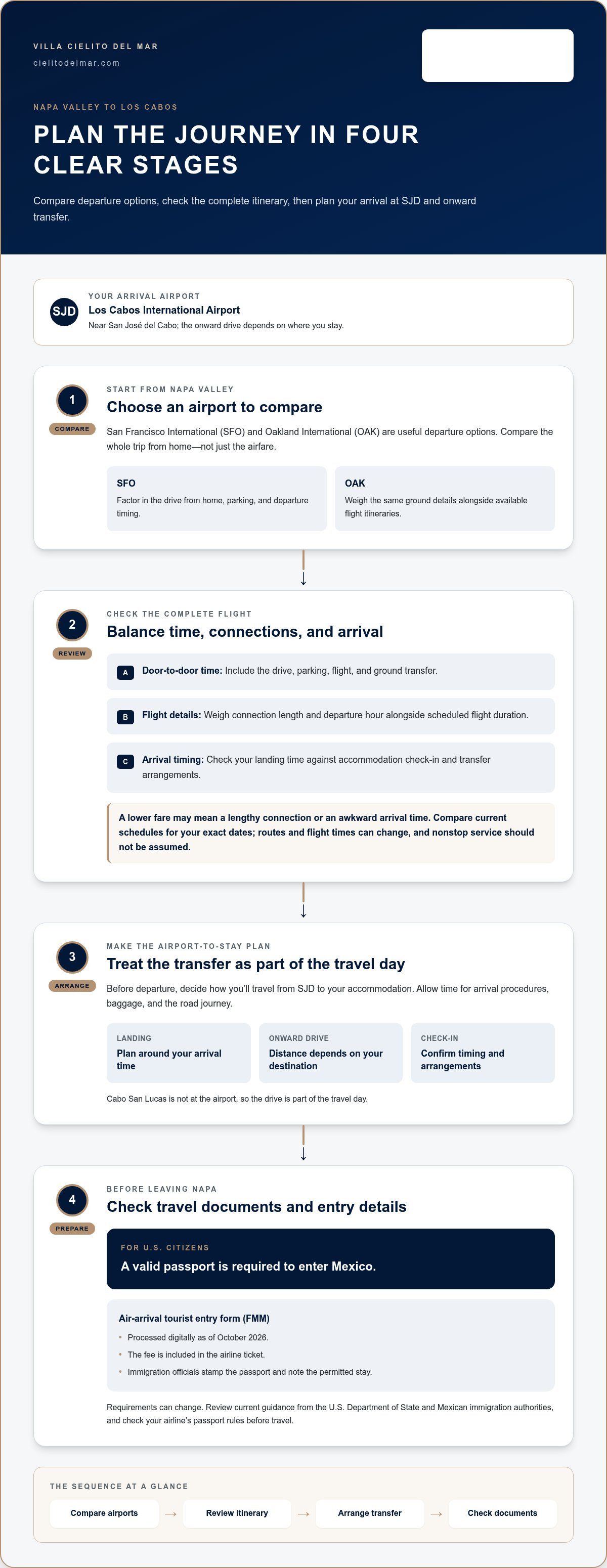
A smooth Napa-to-Cabo journey is planned in sequence: compare departure airports, review complete flight itineraries, then arrange ground transportation for your arrival. Los Cabos International Airport (SJD), near San José del Cabo, is the principal arrival airport for the region. Your onward drive depends on where you’re staying, so plan that final leg as part of the trip, not as an afterthought.
San Francisco International Airport (SFO) and Oakland International Airport (OAK) are useful options to compare from Napa Valley. The better choice depends on more than the fare or time in the air. Consider the drive from home, parking, departure hour, connection points, and total door-to-door time. A lower fare may not make for a simpler trip if it requires a lengthy connection or an awkward arrival time.
Review schedules for your exact dates before booking: routes and flight times can change, and nonstop service shouldn’t be assumed. As of October 2026, airlines serving the Oakland-to-Los Cabos route included Southwest, Volaris, and Frontier. Check current schedules directly before making plans. Compare your arrival time at SJD with your accommodation’s check-in arrangements and onward transfer. The best itinerary balances total journey time, connections, and ground transfers.
• Compare the full drive-and-flight journey from SFO and OAK, including parking and departure timing.
• Weigh connection length and arrival hour alongside scheduled flight duration.
• Plan your transfer from SJD around your landing time and destination.
Before departure, decide how you’ll travel from the airport to your accommodation. Allow time for arrival procedures, baggage, and the road journey. Transfers are especially important to plan around your chosen area: a stay in Cabo San Lucas is not at the airport, so the drive is part of the travel day. Confirm timing and arrangements for your itinerary before leaving Napa.
U.S. citizens need a valid passport to enter Mexico. For air arrivals, Mexico’s tourist entry form, the FMM, is processed digitally as of October 2026, with its fee included in the airline ticket. Immigration officials stamp the passport and note the permitted stay. Requirements can change, so review current guidance from the U.S. Department of State and Mexican immigration authorities, and check your airline’s passport rules before travel.
Once the travel day is mapped out, the stay itself can feel less hurried. For groups seeking a shared base with private space, Villa Cielito del Mar’s beachfront estate is rented as one entire property in Cabo San Lucas.
Los Cabos is not one continuous resort district with a single character. Choosing between Cabo San Lucas, San José del Cabo, and Chileno Bay shapes the atmosphere you return to after a day out, as well as the balance between time in town and time at your accommodation. Use this comparison to identify which setting best supports your group’s priorities, rather than looking for one universally “best” area.
Think of the region as two distinct towns connected by a coastal corridor, with Chileno Bay among its coastal settings. This simple orientation makes the place names easier to distinguish:
| Area | Atmosphere | May suit travelers prioritizing | Geographic position |
|---|---|---|---|
| Cabo San Lucas | Lively, with a marina and town energy | Time around the marina, dining, and a central town setting | One end of the Los Cabos corridor |
| Chileno Bay | Coastal and distinct from either town center | A stay oriented around its coastal setting | Along the corridor between the towns |
| San José del Cabo | Quieter and more historic, with galleries and a colonial character | A slower town atmosphere and cultural browsing | The other end of the corridor |
The corridor connects the two towns across roughly 20 miles, so location matters if you expect to travel between them. Chileno Bay is a separate coastal setting within the wider Los Cabos area, not another name for Cabo San Lucas or San José del Cabo.
Start with the experience your group values most. If you picture evenings around a lively town, Cabo San Lucas may fit. If a historic atmosphere and galleries appeal, consider San José del Cabo. Chileno Bay may suit a trip centered more on coastal surroundings. These are starting points, not rules. Dining plans, sightseeing, and the amount of time you hope to spend at your accommodation all influence which base makes sense.
For a group that wants shared spaces and a more secluded stay in Cabo San Lucas, Villa Cielito del Mar is a private beachfront estate rented as one entire property. Its grounds and oceanfront palapa make staying in part of the experience, rather than simply a pause between outings. This Cabo travel guide for Napa Valley residents is ultimately about matching the setting to your own pace, while considering local transfers and group preferences alongside the scenery.
A restorative Cabo stay doesn’t require a full calendar. Plan around arrival and departure first, then choose a few priorities and leave breathing room between them. For Napa travelers balancing group preferences, travel fatigue, and the wish to explore, a simple framework can make each day feel intentional without feeling overplanned.
Keep the first day light. After the journey, settle in, get comfortable with your surroundings, and share a meal or watch the changing light along the coast. Save the main outing for a day when the group has energy, whether that means exploring a town or choosing another experience that suits everyone. Leave another stretch of time open for reading, conversation, or simply being outdoors.
Give departure day the same consideration as arrival. Keep plans close to your accommodation, allow time to gather belongings, and leave room for the ground transfer and airport arrival. A useful sequence is:
Settle in, orient the group, and keep the evening unhurried.
Choose a single priority, with time around it rather than back-to-back commitments.
Leave space for a shared meal, coastal views, or quiet hours outdoors.
Keep the schedule simple and plan around transportation.
Consider the conditions your group prefers before settling on dates. December through April is the peak season, with pleasant weather and opportunities for whale watching. September and October are among the least expensive months, but fall within hurricane season. These broad patterns are a starting point, not a forecast. Check current seasonal guidance and weather information before travel, and verify activity schedules and weather-sensitive arrangements close to your dates.
Group needs matter as much as the calendar. One traveler may welcome a full day out, while another would rather linger at the accommodation. Some may prefer a shared meal, while others value time alone. Build in options instead of expecting everyone to follow the same rhythm. A private setting can help: Villa Cielito del Mar is an entire eight-bedroom beachfront estate in Cabo San Lucas, with grounds and an oceanfront palapa that offer room to gather or find a quieter corner. Its gourmet kitchen gives the group space to enjoy meals together at its own pace.
Use this Cabo travel guide for Napa Valley residents as a reminder to plan the essentials, then let the days breathe. Explore a private Cabo estate stay as a setting for a more measured group escape.
For a group traveling together, where you stay can shape the pace of the trip as much as what you plan to do. An exclusively rented estate gives everyone a shared setting for meals and conversation, while allowing the group to settle into a private stay rather than booking separate hotel rooms. The appeal is togetherness without requiring everyone to spend every hour in the same place.
Booking an entire property means the group shares one residence rather than reserving rooms individually. Common areas make it natural to gather, while the estate’s bedrooms and grounds offer room for quieter moments. For a Napa group with different routines or energy levels, this arrangement makes it easier to balance time together with personal space.
Villa Cielito del Mar is rented exclusively as one property. Its eight bedrooms, gourmet kitchen, private grounds, and oceanfront palapa give a group distinct places to come together or enjoy the surroundings at a gentler pace. The kitchen provides a setting for preparing and sharing meals; the estate is not an all-inclusive meal package. It’s a private base where the group can shape the day around its preferences.
Set on the beachfront in Cabo San Lucas, Villa Cielito del Mar was originally designed by Cliff May and remodeled for modern luxury standards. Its architectural history and updated finish meet the coastline in a setting suited to unhurried mornings and evenings outdoors. The grounds and oceanfront palapa extend the living space beyond the interior, connecting time at the estate with its beachfront surroundings.
In this Cabo travel guide for Napa Valley residents, choosing a private estate is one way to make the stay part of the escape, rather than simply a place to return between outings. It may appeal to groups who value shared spaces, a gourmet kitchen, and room to enjoy different rhythms under one roof. The right stay depends on how your group wants to spend its time, whether gathering over a meal, taking in the oceanfront setting, or seeking a little quiet.
For a closer look at a private group stay, explore Villa Cielito del Mar and consider how its beachfront estate could suit your Cabo plans.
A thoughtful trip begins with practical choices: compare Napa-area departure airports and current flight itineraries, plan the transfer from Los Cabos International Airport, and choose a base that suits your group. Cabo San Lucas, San José del Cabo, and Chileno Bay each offer a distinct setting. A few considered plans and open time can keep the days restorative rather than overfilled.
This Cabo travel guide for Napa Valley residents is a starting point for shaping an escape around your own rhythm. For a group seeking privacy alongside shared spaces, Villa Cielito del Mar is an entire eight-bedroom beachfront estate in Cabo San Lucas, rented exclusively as one property. Its gourmet kitchen, private grounds, and oceanfront palapa create room to gather or retreat. Originally designed by Cliff May and remodeled for modern luxury standards, the estate offers a distinctive setting for time together by the coast.
Explore Villa Cielito del Mar as you plan your stay, and look forward to a Cabo escape shaped by thoughtful preparation and unhurried moments.
Whether you’re planning from Napa Valley or coordinating with family in San Diego, Dallas, Houston, or Los Angeles, these answers offer a concise starting point for Cabo travel decisions.
From Napa Valley, compare itineraries departing San Francisco International Airport (SFO) and Oakland International Airport (OAK), weighing total journey time, connections, parking, and arrival hour. Fly to Los Cabos International Airport (SJD), then arrange ground transportation to your accommodation. Review current 2026 airline schedules rather than assuming a nonstop flight. This Cabo travel guide for Napa Valley residents recommends planning the airport transfer alongside your ticket, so landing and check-in timing work together.
Fly into Los Cabos International Airport (SJD), near San José del Cabo. It serves as the region’s main air gateway, including for visitors staying in Cabo San Lucas, who will need onward ground transportation after landing. Allow time for arrival procedures, luggage, and the drive to your accommodation. Confirm current flight schedules and transfer timing for your dates, since your final destination affects the travel day.
No. Cabo San Lucas is one town within Los Cabos, the broader destination region that also includes San José del Cabo and the coastal corridor between them. Chileno Bay is a distinct coastal setting within the wider region, not another name for either town. The distinction matters when choosing where to stay: each area has its own atmosphere, and your location shapes how you plan outings and local transfers.
There’s no single ideal trip length; choose one that leaves time to enjoy Cabo beyond the airport journey. Treat arrival and departure as travel days, rather than assuming each offers a full day for activities. For a shorter escape, aim to preserve at least one full day for an outing or relaxed time at your accommodation. Add time if you want to explore more than one Los Cabos area without rushing.
Yes. U.S. citizens need a valid passport to enter Mexico, and it must be valid for the duration of the stay. Some airlines may require at least six months of remaining validity, so review your carrier’s current rules before departure. For air arrivals, Mexico’s tourist entry form is processed digitally as of October 2026. Check current entry guidance with official U.S. and Mexican sources before traveling.
December through April is peak season, with pleasant weather and opportunities for whale watching. September and October are among the least expensive months, but they fall within hurricane season. The best timing depends on your preferred conditions and plans. Before booking activities, review current seasonal weather guidance and confirm schedules for experiences that depend on weather, including outdoor outings. Conditions can vary, so use current forecasts as your travel dates approach.